Mohsen Veysi
Artist, Researcher, and Educator
Early Life and Artistic Beginnings
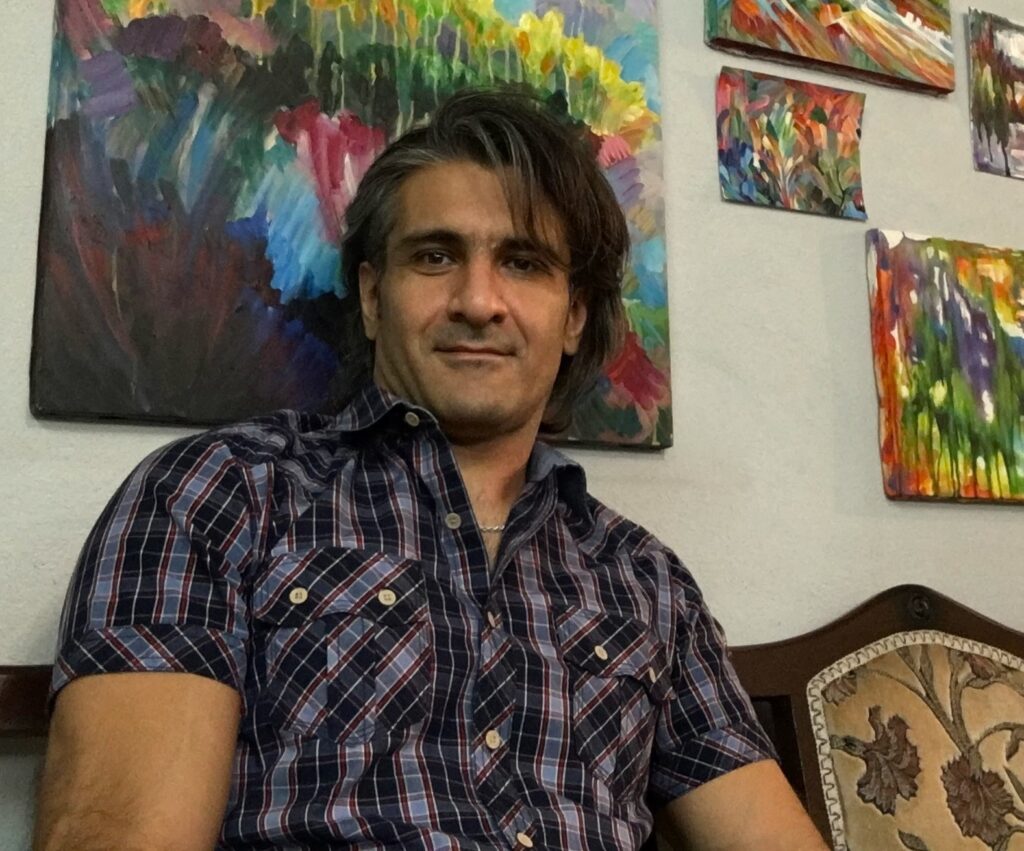
Mohsen Veysi is an artist-scholar who was born and grew up in Kermanshah, Iran. His interests in art come from his childhood: “my father used to help me hold a pen in my hand and draw. My aunt who was a painter used to tell me about great masters and show me their works to inspire me. Soon, I became an unstoppable drawing machine,” he says. In a society where most people want their children to become doctors and engineers, he chose to follow his passion for art. “That was like swimming against the tide, so frustrating. Most people who knew me thought I was crazy. I don’t know, maybe they were right.
On his way to art, he decided to move to Florence and study painting. It was a very tough goal to achieve. With the lack of possibilities and so many obstacles to face, it was like a mountain to climb. “But for he who was grown up in mountainous lands climbing mountains is not that hard.” In Italy, he earned his academic diploma from the Accademia di Belle Arti di Firenze in visual arts. After the traditional and historical experience of Florence, he moved to the US to expand his knowledge of American contemporary art, earning a Master of Fine Arts from the University of Cincinnati, Ohio.
Artistic Practice
His main source of inspiration in his studio practice is poetry. His entire body of work is based on the interaction of visual and verbal, artist and poet, image and text. His works are characterized by his approach to diverse Persian and Latin calligraphic styles to visualize poetry in both original language and their translations. For him, calligraphy works as “a vehicle that carries poetry and transfers it to the viewers’ eyes.” Through his work, each poem becomes an image, and each image becomes a visual poem.
Transcultural Identity
Both his artistic practice and his research are deeply influenced by his multicultural and multilingual experiences of living, studying, and teaching in Iran, Italy, the US, and other countries. These experiences have shaped Mohsen’s transcultural identity, forming the core of his existential and artistic philosophy. Living across different cultures has instilled in him a profound understanding of how artistic, linguistic, and cultural traditions intersect and influence each other. This transcultural perspective informs his studio practice, where diverse calligraphic and visual languages converge; his teaching, guiding students to engage with art across cultural and historical contexts; and his approach to life, emphasizing curiosity, dialogue, and the unity of seemingly disparate worlds.
Academic and Teaching Background
While studying studio arts, he took many art history courses to deepen his understanding of art history and theory. “Apart from my interests, I needed to know why Michelangelo’s David, and Jeff Koons’s Rabbit are both masterpieces. Plus, when you come from a non-Western background, you must read more about Western art history to be able to link it to your native artistic traditions.”
Experiences of living in different countries with diverse art, cultures, languages, traditions, lifestyles, and confronting various definitions of art brought him up to questions such as: what makes each artist’s art unique? What makes each culture’s art diverse? What makes each era’s art different and unrepeatable? Finding the answers to these questions led him to study human sciences concentrating on art history and aesthetics as his Ph.D. major at the University of Modena and Reggio Emilia, Italy. In his Ph.D. dissertation titled “Kunstwollen: A Contemporary View – Local, Global, Transcultural”, he focused on Alois Riegl’s theory of Kunstwollen (will to art) concerning global art production. The first chapter of his dissertation will soon be published as a book.
Art History in Practice
After years of studying and teaching both studio arts and art history, Mohsen developed a distinctive approach he calls Art History in Practice — an educational method that bridges academic insight with hands-on creation. He believes that teaching art history to practicing artists should be different from teaching it to art history majors: it must be directly applicable to creative practice, encouraging artists to engage with historical techniques, ideas, and contexts in a way that informs and inspires their own work.
Transcultural Art Space (TAS)
Building on his lifelong commitment to bridging cultures, languages, and artistic traditions, Mohsen founded Transcultural Art Space (TAS) — a borderless platform that unites art, education, and immersive cultural experiences. Through TAS, he designs and leads art journeys, retreats, workshops, and online courses that allow participants to engage deeply with art history and studio practice, in both physical and virtual spaces. TAS embodies Mohsen’s philosophy of experiential learning, where art is not only studied but felt, created, and experienced in its cultural context.
ARTIST STATEMENT
I draw inspiration from poetry to create a new poem through colors, lines, words, and images—a poem inspired by another poem, a reflection on it, a poem about a poem. It’s a meta-poem, where the visual and the written intertwine to form something entirely new. I define myself as an “artistpoet,” embodying the seamless union of these two creative realms. As an artistpoet, I merge the worlds of visual art and poetry, creating dynamic works that explore the intersection of language, imagery, and cultural expression. Inspired by literature, I use calligraphy as a vital medium that bridges the realms of text and visual arts. By blending Persian and Latin calligraphy, I visualize poems in both their original language and translation, emphasizing themes of transculturation and fostering transcultural dialogue. My choice of materials, such as watercolor and ink, reflects the fluidity of life and the permanence of words. Through translucent layers and bold contrasts, I capture the delicate balance between the ephemeral and the enduring, inviting viewers to engage with art and poetry in new and meaningful ways. In my work, I strive to transcend cultural and linguistic boundaries, creating spaces for understanding and connection, ultimately embodying the seamless union of art and poetry.
RESEARCH INTERESTS
The History of drawing, text & image, drawing & poetry, Persian art & calligraphy, global art history, neuroaesthetics, neuroarthistory, and the historiography of Alois Riegl.
EDUCATION
- Ph.D. Human Sciences, University of Modena and Reggio Emilia, Italy (2020)
Dissertation title: Kunstwollen: A contemporary View – Local, Global, Transcultural - MFA, University of Cincinnati, OH, USA (2016)
Thesis title: Portrait of a poet, portrait of a poem - M.A. Visual Arts-New Media, Accademia di Belle Arti di Florence, Italy (2014)
Thesis title: La Linea, L’Uomo, e Il Tempo (Line, Human, Time) - BFA, Painting, Accademia di Belle Arti di Firenze, Italy (2011)
Thesis title: Disegno è un‘Opera d’Arte (Drawing as an Art Form)
CERTIFICATIONS
- Foundations of Neuroscience, The Johns Hopkins University | Coursera, (2025)
- Visual Perception and the Brain, Duke University | Coursera, (2025)
- ISSA Certified Personal Trainer & Nutritionist | CPR/AED Trained, (2024)
- Master of Excellency (Momtaz) in Persian Calligraphy , Society of Iranian Calligraphers, (2003)